By Arrif Asava, for Bombellii Ventures
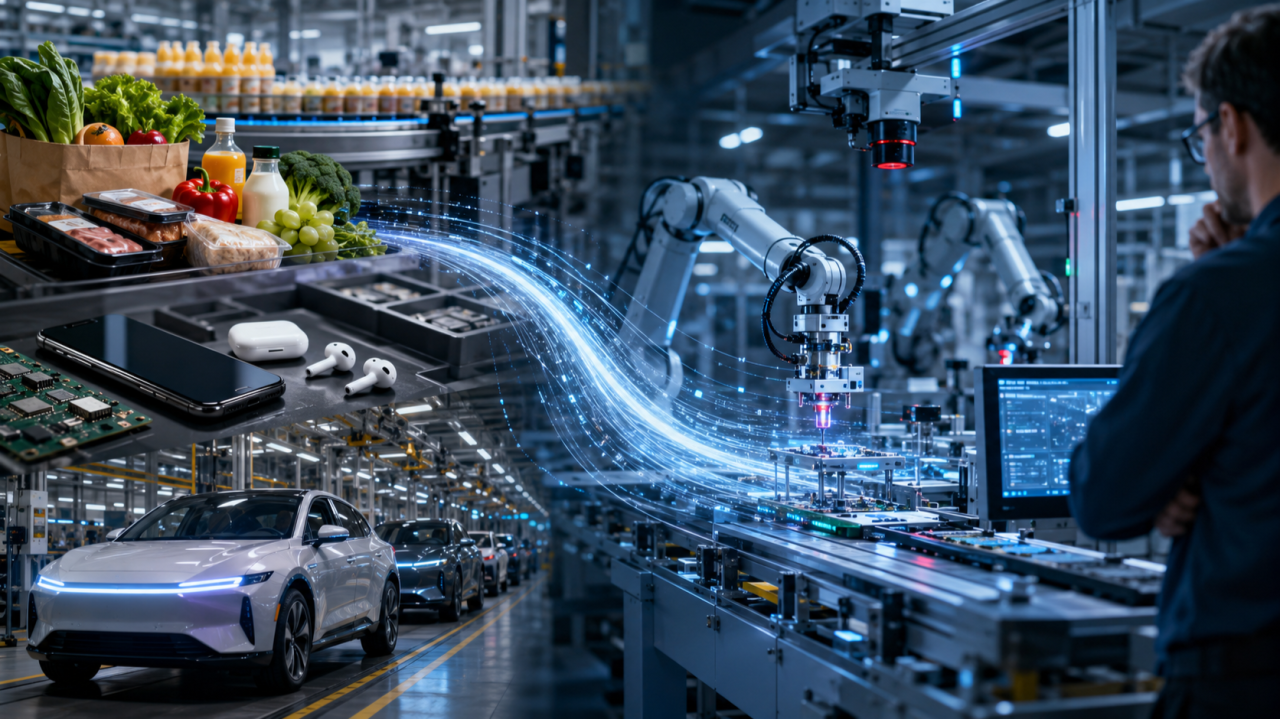
When most people think about AI, they think about ChatGPT, Claude, or software that helps people work faster. But some of AI’s biggest impact may happen far from the screen but on the factory floor.
Manufacturing produced about 15% of global GDP in 2024 and 2025. The car we drive, the phone we use, the food in the supermarket, and the medicine in a hospital all begin with physical production. When factories run better, everyday products can become cheaper, arrive faster, and be easier to find. When they fail, the effects can reach consumers through shortages, delays, and higher prices.
Factories also have a major climate footprint. Industry accounts for nearly 30% of global greenhouse-gas emissions and close to 40% of global energy demand. Automation could reduce this footprint by cutting scrap, preventing equipment failure, and using energy more efficiently. But more robots, sensors, and computing systems also require electricity and new hardware. The climate impact will therefore depend on whether efficiency gains grow faster than the energy and materials required to automate.
This is where Physical AI becomes important. It brings intelligence into cameras, sensors, machines, robots, and the systems that connect them.
The real question is not whether AI will enter factories. It already has. The more important question is where it can create lasting value – and where startups can still build something difficult to copy.
1. AI Is Moving from Screens to the Physical Economy
The smart-manufacturing market was worth about $410.7 billion in 2025 and is projected to exceed $1 trillion by 2033. In 2024 alone, factories installed 542,000 industrial robots worldwide more than twice the number installed a decade earlier.
On the factory floor, AI can inspect products, predict equipment problems, simulate production changes, coordinate robots, and help workers respond faster. The result is not simply better information. It can change how goods are made, fewer defects, shorter delays, steadier output, and less wasted material.
2. Why Factories Are a Hard but Valuable AI Market
Many plants still run on machines built decades ago by different vendors. Data may be missing, stored in separate systems, or recorded in incompatible formats. A model that works on one production line may not work the same way on another.
The risk is also higher. A poor office-software suggestion may waste a few minutes. A poor factory decision can stop production, damage equipment, or create a safety problem. Deloitte has estimated that unplanned downtime costs industrial manufacturers about $50 billion a year, while weak maintenance practices can reduce plant capacity by 5% to 20%.
This makes deployment slower. Startups must connect to old equipment, work with imperfect data, fit into daily operations, and earn the trust of engineers and technicians.
But the difficulty can become a moat. Once a product works reliably, proves savings, and becomes part of the plant’s normal workflow, replacing it is costly and risky.
3. The Physical AI Value Chain
Physical AI in manufacturing works through four connected layers.
Hardware and data collection
Sensors, cameras, industrial robots, edge computers, and machine controllers collect information from the factory floor: vibration, temperature, pressure, images, speed, and machine status. Without reliable inputs, even a strong AI model has little value.
Industrial data layer
The data layer connects machines, cleans the information, and adds production context. It includes maintenance records and manufacturing execution systems (MES), which track what is being produced, which machine is running, and whether the line is meeting its target.
Intelligence layer
The intelligence layer turns factory data into useful decisions. Machine vision checks products for defects, predictive maintenance monitors equipment health, digital twins simulate machines and production lines, process optimization improves factory performance, and robot-coordination software manages tasks and movement.
Deployment layer
The final layer makes the system usable in a plant. It includes system integration, upgrades to old equipment, workflow changes, safety checks, and cybersecurity. Many promising pilots fail here because the model works, but the product does not fit the factory.
The key question is whether a company can connect these layers and turn factory data into a useful decision. If it can, AI becomes more than a monitoring tool, it can help factories improve quality, prevent downtime, and run more efficiently.
The attractiveness of each market depends on where value sits across the four layers. Established companies often control the hardware and data layers. New startups may have more room in the intelligence and deployment layers, where they can solve a narrow decision or workflow faster.
4. The Top Five Investment Areas
The opportunities across the factory stack are developing at different speeds. Some have clear demand today; others are harder to build but may create deeper value over time.
4.1 Machine Vision and Quality-Control AI
The machine-vision market was worth about $22.6 billion in 2025 and is projected to reach $61.0 billion by 2033.
Machine vision is one of the clearest ways for AI to enter a factory. Cameras can detect scratches, wrong dimensions, missing parts, poor assembly, and packaging errors. Compared with manual inspection, AI can check every unit and apply the same standard across shifts.
Machine vision already has a mature hardware and data-collection layer. Cameras, lighting, and edge processors are widely available, and many systems can detect visible defects reliably.
The industrial data layer becomes more important when the goal moves from seeing a defect to explaining it. The bigger bottlenecks sit in the intelligence and deployment layers, where models must handle changing products and factory conditions, then fit into the quality workflow. This leaves room for AI-native startups that combine image data with machine and process data and turn inspection into a useful decision, not just another alert.
4.2 Predictive Maintenance
The predictive-maintenance market was worth about $14.2 billion in 2025 and is projected to reach $98.1 billion by 2033 – annual growth of roughly 27.9%.
Predictive maintenance focuses on the health of the machine itself. AI studies vibration, temperature, pressure, electrical current, sound, operating history, and maintenance records to detect early signs of wear.
The first generation mainly sends alerts “This machine is behaving abnormally.” The broader field includes established platforms such as Augury, TRACTIAN, AssetWatch, Infinite Uptime, and Nanoprecise; asset-specific companies such as Gecko Robotics, ONYX Insight, and MachineMetrics;
The larger opportunity is to move through the full workflow: detect > diagnose > recommend > execute. The system should identify the likely cause, estimate urgency, recommend the repair, check the required part, and create the work order.
Established platforms already have an advantage in the first two layers through installed sensors, large machine datasets, integrations, and reliability expertise. But the industrial data layer is still fragmented because maintenance history, machine context, and failure records often sit in separate systems. This pushes the biggest opportunity into the intelligence and deployment layers, where the challenge is to turn scattered data into a trusted maintenance decision.
A native-AI startup does not need to replace the sensor layer. It can use existing sensor data, CMMS records, manuals, and technician notes, focus on one asset and failure mode, and turn diagnosis into repair timing, a parts decision, or a work order. The best entry point is a narrow workflow where better decisions and faster deployment matter more than owning the largest historical dataset.
4.3 Digital Twins and Simulation
The digital-twin market was worth about $35.8 billion in 2025 and is projected to reach $328.5 billion by 2033 – the fastest growth among the five areas.
A digital twin is a virtual model of a machine, robot, production line, or factory. It lets engineers test changes without risking real production. A plant can compare layouts, train robots, test production schedules, or estimate how an asset behaves under heavier load.
The opportunity includes factory design, simulation, robot training, asset-health models, and repair scenarios. The risk is accuracy: a twin is only useful if it reflects the real system closely enough. Building that model can be expensive and dependent on high-quality data.
Its strongest link to predictive maintenance is decision support. A twin can help estimate how damage will develop, how long an asset can keep running, and whether repair or replacement is the better choice.
Large incumbents already control much of the data foundation. For example, AVEVA’s CONNECT platform links engineering, operational, and enterprise data with models, analytics, and visualization. Hexagon combines reality-capture, quality, simulation, and real-time manufacturing data to create digital feedback loops. A startup is unlikely to win by building another general-purpose digital-twin platform.
The bottleneck sits between the industrial data, intelligence, and deployment layers. Data must stay synchronized, the model must predict behavior accurately, and engineers must trust the output. A startup is more likely to win by using existing platforms and solving one narrow decision, such as remaining life, production optimization, or repair versus replacement, rather than building another general-purpose twin.
A better starting point is one asset, one decision, and one repeatable deployment, for example, estimating the remaining life of one component, optimizing one production step, or recommending repair versus replacement while integrating with the incumbent data platforms rather than replacing them.
4.4 Industrial Data Layer and Manufacturing Execution Systems (MES)
The MES market was worth about $17.6 billion in 2025 and is projected to reach $41.6 billion by 2033.
In many plants, information is trapped inside machines, spreadsheets, maintenance systems, and software from different vendors. One system records output, another holds repair history, and an older machine may not be connected at all.
The industrial data layer brings this information together. It connects old equipment, cleans the data, and adds context such as the product, shift, load, and production target.
The deployment layer is therefore the real test. AI can help map and clean data, but a startup only scales if the same connector or vertical data model works across many sites. Otherwise, the product becomes a custom integration business.
For investors, the industrial data layer is the hidden enabler: without reliable machine data, production context, and maintenance history, predictive maintenance remains a weak alert system.
4.5 Cobots and Robot Software
Cobots accounted for about 11% of industrial-robot installations in 2023, while annual industry sales approached $3 billion. Global factories then installed 542,000 industrial robots in 2024, showing the scale of the wider robot base.
Cobots are designed to work near people and handle tasks that change more often. AI can improve vision, motion, programming, task planning, safety, and fleet coordination. As robot fleets grow, factories will also need to predict battery wear, joint problems, motor degradation, calibration drift, and gearbox failure before those issues disrupt production.
Robot hardware is increasingly mature, so the bottleneck is moving above the hardware and data-collection layer. Robots generate rich operating data, but different vendors expose it in different formats. Platforms such as Formant, InOrbit, KINEXON, Olis Robotics, and Korial already provide monitoring, coordination, and recovery, but the industrial data, intelligence, and deployment layers remain less developed.
This creates an opening for software that normalizes cross-brand data, predicts wear, and turns health signals into fleet decisions such as moving tasks, reducing load, or scheduling service. For investors, the opportunity is not another monitoring dashboard. The stronger moat may come from cross-OEM integration and workflow ownership that can turn robot health into a trusted repair or fleet decision.
5. Predictive Maintenance May Be the Strongest Future Bet … Why?
Predictive maintenance addresses one of the factory’s biggest problems, unplanned downtime and unstable equipment performance. Today, many systems already collect sensor data, detect unusual behavior, and send alerts. The bigger opportunity begins after the alert.
Hardware and data collection are relatively mature. Factories already use vibration, temperature, pressure, current, and other sensors. Established platforms also benefit from years of machine data. A new startup does not need to win by installing more sensors.
The industrial data layer is still fragmented. Maintenance history, operating context, manuals, and technician notes often sit in separate systems. Without that context, an alert may show that something is wrong but not explain why.
The largest gap is in the intelligence layer. A useful system should move beyond “this machine looks abnormal” and answer what is failing, how urgent it is, and what should be done next. AI can combine sensor data with maintenance records, manuals, and technician feedback to improve that diagnosis over time.
The deployment layer is where the decision becomes valuable. A recommendation only matters if it reaches the actual workflow. The software should be able to create a work order, identify the required part, schedule maintenance, reduce machine load, or move production to another asset.
This creates a clear path from detect > diagnose > recommend > execute.
The strongest startup may therefore begin narrowly, with one industry, one asset type, and one failure mode. A chemical-plant startup might focus on pump failures, while a warehouse product might predict battery and wheel wear across AMR fleets. Once the system proves that it can make a trusted maintenance decision, it can expand across similar assets and sites.
The investment conviction is strongest here because the first two layers already prove demand, while the last two remain incomplete. Factories already spend money on sensors, monitoring, and maintenance software. The remaining whitespace is the decision layer that turns machine-health data into a reliable action. If a startup can own that workflow, it can become harder to replace than another monitoring dashboard.
6. Conclusion
The next wave of AI may be embedded in cameras that inspect products, sensors that monitor machines, robots that move through factories, and systems that decide when equipment should be repaired.
Machine vision may be the clearest near-term entry because its results are visible and measurable. Digital twins offer platform potential. Industrial data provides the foundation. Robot software opens a newer market.
But predictive maintenance may offer the deeper long-term opportunity. It moves the factory from reacting to defects and breakdowns toward preventing them.
The largest winners may be the companies that identify why it is happening, decide what should happen next, and help execute that decision.
The next AI platform may not be another app. It may be the factory floor, where software meets machines, and where better intelligence can improve how reliably the physical economy operates.
The market is already large and growing quickly: predictive maintenance was valued at $14.2 billion in 2025 and is projected to reach $98.1 billion by 2033.
Selected Sources and Research
- World Bank / World Development Indicators, manufacturing value added as a share of global GDP, 2024.https://data.worldbank.org/indicator/NV.IND.MANF.ZS
- UNIDO Global Highlights 2025. https://stat.unido.org/portal/storage/file/publications/yb/2025/UNIDO_IndustrialStatistics_Global_Highlights_2025.pdf
- United Nations Industrial Development Organization, industrial energy use and greenhouse-gas emissions. https://www.unido.org/our-priorities/clean-energy-and-climate-action
- Grand View Research, Smart Manufacturing Market Size & Share Report, 2026-2033. https://www.grandviewresearch.com/industry-analysis/smart-manufacturing-market
- International Federation of Robotics, World Robotics 2025: 542,000 industrial robots installed in 2024. https://ifr.org/ifr-press-releases/news/global-robot-demand-in-factories-doubles-over-10-years
- Deloitte, Predictive Maintenance and the Digital Supply Network; estimates on downtime cost and lost plant capacity. https://www.deloitte.com/us/en/insights/industry/manufacturing-industrial-products/industry-4-0/using-predictive-technologies-for-asset-maintenance.html
- Grand View Research, Machine Vision Market Size and Share Report, 2026-2033. https://www.grandviewresearch.com/industry-analysis/machine-vision-market
- Grand View Research, Predictive Maintenance Market Size & Share Report, 2033. https://www.grandviewresearch.com/industry-analysis/predictive-maintenance-market
- Grand View Research, Digital Twin Market Size and Share Report, 2033. https://www.grandviewresearch.com/industry-analysis/digital-twin-market
- Grand View Research, Manufacturing Execution Systems Market Report, 2026-2033. https://www.grandviewresearch.com/industry-analysis/manufacturing-execution-systems-market-report
- Financial Times, ‘March of the cobots,’ citing IFR and Grand View Research data. https://www.ft.com/content/78c1d4e9-ad30-47f5-ab7b-390df5bc1f10