Human survival is measured in extremes: a few weeks without food, days without water, minutes without oxygen. Over the past 25 years, air quality has improved in many regions thanks to reductions in CO, NO₂, SO₂, lead, particulate matter, and the successful recovery of the ozone layer. Nonetheless, significant challenges remain; urban air pollution, wildfire smoke, and emerging chemical contaminants continue to pose health risks, especially in rapidly industrializing areas.
Meanwhile, the state of freshwater resources presents an even more pressing and systemic concern, influencing not only human life but also food production, energy systems, and technological infrastructure.
Global freshwater per capita has declined by roughly 7% in the past decade, driven by climate pressures, rising demand, and population growth. Since 2000, water use has risen approximately 25%, especially in already water-stressed regions, signaling a shift from localized scarcity to a systemic geopolitical and economic risk.
Global Water Scarcity Outlook
a. Scale of the Crisis
Roughly 4 billion people face severe water scarcity for at least one month per year, and over 2 billion lack safely managed drinking water. By 2050, water demand is projected to outstrip supply by 40%, placing 4.8–5 billion people under stress.
b. Geopolitical Dimensions
Shared rivers such as the Nile, Indus, Mekong, and Colorado heighten tensions between nations, driving investments in desalination, wastewater recycling, precision irrigation, atmospheric water generation, and digital water infrastructure. Control over water resources is increasingly recognized as a strategic lever for national security, economic resilience, and technological competitiveness.
c. Upcoming Challenges
Climate volatility, population growth, urbanization, and industrial demand, coupled with aging infrastructure, will reshape food production, migration patterns, energy systems, and urban planning. By 2050, water-related displacement could affect 700 million–1.8 billion people, further compounding political instability. Emerging demands from AI infrastructure will also place unprecedented pressure on already stressed water systems.
The Water-Compute Nexus
a. Why Water Matters to Data Centers
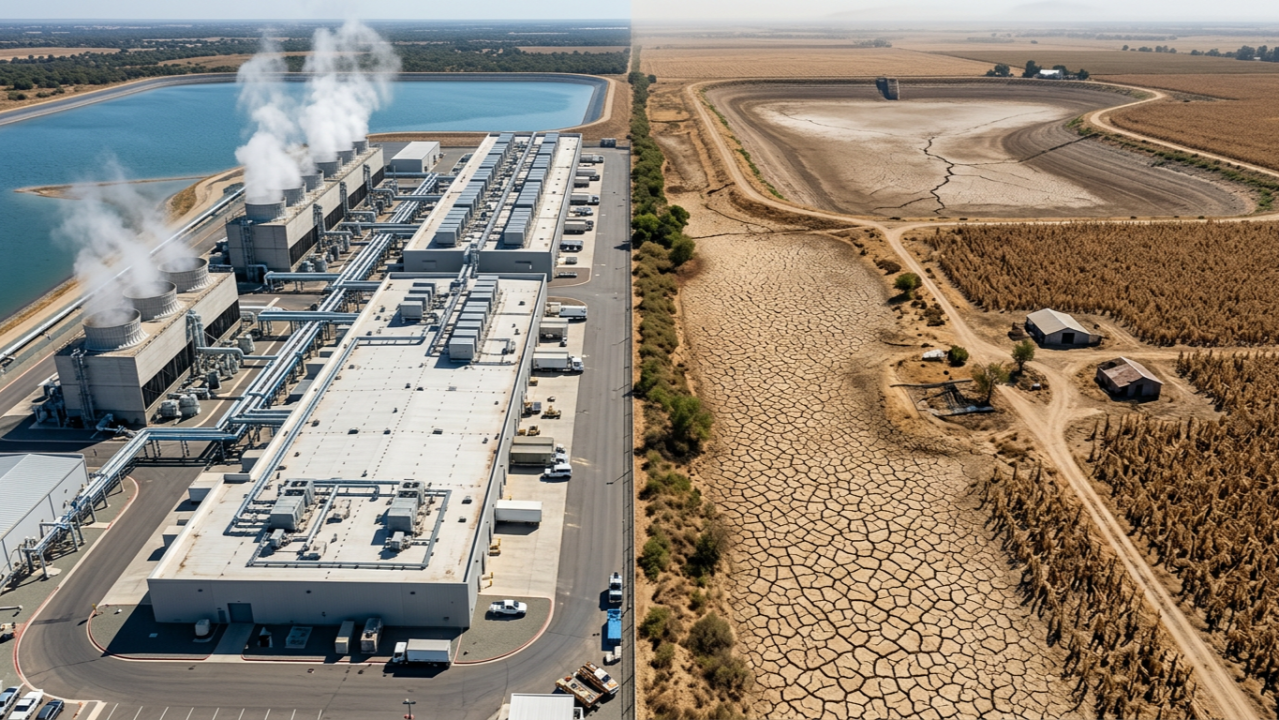
AI infrastructure requires enormous energy, high-performance hardware, and reliable cooling systems. Today, cooling is increasingly water-dependent, making freshwater availability a limiting factor. Tech hubs such as the US Southwest, Northern Virginia, California, India’s tech corridors, and parts of China face simultaneous droughts, groundwater depletion, and population pressures, creating vulnerabilities for both digital and human systems.
b. AI’s Water Footprint
As AI adoption accelerates, the total water footprint of the global AI industry could rise dramatically. By 2030, the AI sector may require over 100 billion gallons of freshwater annually, rivaling the water consumption of small nations. Water scarcity directly constrains computing throughput. Concentration of AI infrastructure in water-stressed regions could exacerbate local scarcity despite investments in water recycling and closed-loop cooling.
c. What to Expect
AI infrastructure may increasingly relocate to water-abundant regions, creating a new layer of digital sovereignty shaped by hydrological capacity. Water-efficient strategies such as submersed data centers, distributed micro-data centers, and even space-based computing could mitigate water risks while maintaining performance. Organizations and nations that integrate hydrological data into AI deployment planning will gain a strategic advantage.
Geopolitics of the AI-Water Race
Water scarcity is a dual threat: it constrains AI infrastructure growth and directly threatens population survival. Nations that fail to secure freshwater risk digital stagnation and human vulnerability, creating potential crises in both technology leadership and civil resilience.
a. At Risk
Regions like India, the Middle East, Southern Europe, and parts of Africa face acute water stress, making them vulnerable to AI infrastructure bottlenecks and population-level water shortages. Without robust management, scarcity may trigger migration, food insecurity, and social instability, alongside digital setbacks.
b. Intermediate
Countries such as the USA (Midwest, Great Lakes, Pacific Northwest), China, and Russia have mixed water security. While some regions are water-rich, others face scarcity and drought, requiring careful regional planning and water-efficient tech adoption to avoid disruptions for both AI operations and human consumption.
c. Advantage
Countries with abundant freshwater, cool climates, and stable governance including Nordic nations (Norway, Sweden, Finland, Iceland), Canada, the UK, Ireland, Brazil, and Chile are well-positioned to host AI infrastructure while ensuring population water security. These nations may emerge as new hubs of digital sovereignty, balancing compute growth with ecological sustainability and social stability.
Conclusion
The strategic shift toward hydrological computing is no longer hypothetical. It is an immediate necessity. AI growth is tightly coupled with water resources, and the global race for digital supremacy will increasingly hinge on hydrological capacity and resilience.
Investments in water-efficient computing, alternative cooling technologies, and strategic relocation are critical to sustaining AI infrastructure while safeguarding human populations. Policymakers, technologists, and investors must integrate water security into digital strategy, recognizing that freshwater scarcity is not only an environmental issue but a geostrategic and humanitarian imperative.
The future of AI is inseparable from the future of water. Nations that align digital ambition with hydrological foresight will command both innovation and influence, while those that ignore this nexus risk falling behind in the most consequential race of the 21st century.