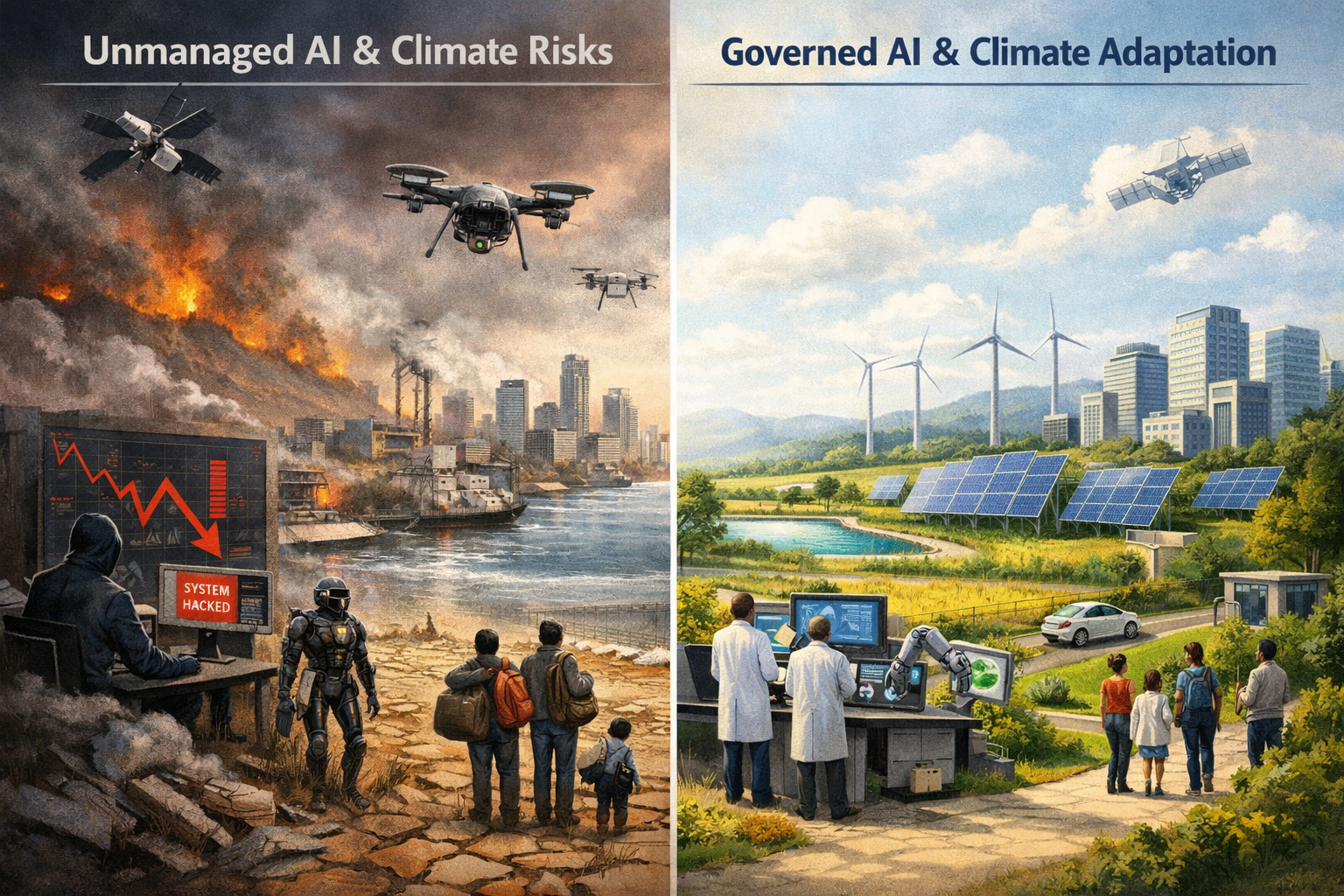
Reclaiming Sovereignty in an Age of Acceleration
Let us begin with a simple definition. Sovereignty is the principle according to which an ultimate and legitimate authority exists, not subordinated to any higher power, whose foundation lies in the people and exercised through institutions.
Today, this principle is under pressure. Societies are overwhelmed by a constant flood of fragmented, contradictory information while facing unprecedented change at unprecedented speed. In such conditions, sovereignty is no longer abstract or symbolic. It becomes operational: the collective ability to decide, act, endure, and protect ourselves over the long term.
One of the clearest expressions of sovereignty is national security. Yet national security no longer stops at borders, armies, or police forces. It now spans a dense web of interdependent domains: cybersecurity; economic, financial, and supply-chain security; energy and resource security; critical infrastructure and continuity; biosecurity and public health; environmental and disaster security; governance and institutional stability; science, technology, and innovation security; societal cohesion demographics and human capital; and space and domain security.
The list is long, complex, and overwhelming. So, a crucial question emerges for us as citizens: Where should we focus our attention and effort to preserve sovereignty in a meaningful way?
1. Why Focus on AI + Climate Sovereignty?
Within this expanded understanding of national security, Climate change and Artificial Intelligence stand out as central, why? Because compared to other National Security domains, they share a unique set of specificities that make them cross-cutting forces that do not merely add new risks but reshape all others.
Existential, Long-Term Risks : Climate change and AI are not short-term disruptions. They are systemic, long-duration, and potentially existential risks. Climate change threatens the physical foundations of civilization: water, food, energy, habitability, and ecosystems. Artificial intelligence reshapes decision-making, labor, warfare, information, and power itself. Poorly governed, it risks eroding human agency, social trust, and democratic control. The development of AI as an autonomous agent (rather than a controlled tool) may itself become a long-term existential threat.
Massive Economic Exposure: The scale of risk is staggering. Uninsured or poorly managed Climate and AI risks are estimated to represent 30% to 60% of global GDP growth over the next 20 years. With global GDP growth averaging roughly $6 trillion per year, this translates into $2 to $4 trillion annually at risk, every year, for two decades. These figures are not abstract. They correspond to destroyed infrastructure, lost productivity, destabilized markets, forced migration, systemic financial shocks, and escalating conflict.
Systemic, Cross-Domain Impact : Climate and AI do not operate in isolation. They directly affect every domain of national security. This systemic reach is precisely why sovereignty over Climate and AI is not one priority among many. This foundational status is even more critical than it may initially appear. Less than 0.5% of the global population is trained in either AI or climate sciences, and these two expert communities scarcely overlap. This structural separation magnifies strategic vulnerability, as decisions in one domain increasingly depend on expertise in the other.
2. Climate Reshapes National Security
Resource Security & Population Survival : What happens when climate change pushes countries into situations where water or energy supply is no longer guaranteed? Water scarcity threatens food production, public health, industrial output, and social stability. Energy insecurity undermines economic activity, healthcare systems, military readiness, and basic governance. When survival itself is at stake, social contracts weaken and political legitimacy erodes.
Geopolitical Tensions & Zero-Sum Dynamics : What happens when Climate change reshapes international relations by turning essential resources into scarce strategic assets? As arable land, freshwater, fisheries, or energy supplies shrink, cooperation gives way to competition. International relations increasingly resemble zero-sum games, especially in already fragile regions. Climate pressure amplifies existing fault lines—between upstream and downstream states, exporters and importers, developed and developing nations—raising the risk of instability and conflict.
Strategic Geography and New Frontiers: What happens when Climate change also redraws the geopolitical map? The Arctic is a striking example. Melting ice opens new shipping routes, access to critical minerals, and military corridors. Strategic balances shift, governance gaps emerge, and security dilemmas multiply. Climate change does not simply add risks; it reconfigures power, space, and time in global security.
3. AI Reshapes National Security
Cognitive, Information, and Political Security: What happens when Elections, public debate, and democratic legitimacy are increasingly exposed to AI-enabled interference? AI exerts unprecedented influence over information flows. It can amplify disinformation, manipulate perception, automate propaganda, and erode trust in institutions. The ability of citizens to form informed, autonomous judgments becomes a core national security issue?
Economic, Industrial, and Labor Security; What happens when supply chains, financial systems, and industrial strategies become AI-dependent, and therefore AI-vulnerable? AI transforms productivity, labor markets, and competitive advantage. Nations that lose control over AI capabilities, data, and computing infrastructure risk structural economic dependency. Entire sectors may be hollowed out, while wealth and power concentrate in a few actors or jurisdictions.
Military and Strategic Stability : What happens when strategic stability is fragilized by machines operating faster than diplomacy, law, or political oversight? AI reshapes warfare through autonomous systems, decision-support tools, cyber operations, and intelligence analysis. Speed increases, human control decreases, and escalation risks rise.
Science, Technology, and Standards Power : What happens when those who define protocols and platforms shape our future digital ecosystem as a complex mosaic of proprietary black boxes? AI leadership is also about setting standards, norms, and architecture. Losing AI sovereignty means losing influence over how power itself is exercised.
Conclusion:
AI + Climate are the forces shaping humanity’s future. They do not merely coexist; they interact and reinforce each other. AI is indispensable for climate modeling, energy optimization, resilient infrastructure, disaster prediction, and adaptation. Yet AI itself consumes vast amounts of energy, depends on critical minerals, and concentrates power in data- and compute-rich regions.
Together, they determine: How societies allocate resources, How risks are anticipated—or ignored, Who benefits from innovation and who bears its costs, Whether transitions are inclusive or destabilizing.
Poor governance will amplify inequality, instability, and conflict. Wise governance could turn AI into a decisive tool for climate resilience and sustainable sovereignty. So, What Should We, the People Do?
Sovereignty ultimately belongs to the people. But sovereignty cannot exist without awareness, competence, and collective will. We must:
- Demand long-term thinking beyond electoral cycles and short-term profits
- Insist on democratic oversight of AI and climate strategies
- Support institutions that prioritize resilience over mere efficiency
- Invest in education and civic literacy on AI, climate, and systems thinking
- Hold leaders accountable for safeguarding national and human security
AI and Climate sovereignty are not technocratic issues reserved for experts. They are civilizational choices.The future will be shaped either by deliberate collective governance or by unmanaged forces acting upon us.
The question is no longer whether these forces will shape our destiny. The question is whether we will retain the sovereignty to shape them in return.