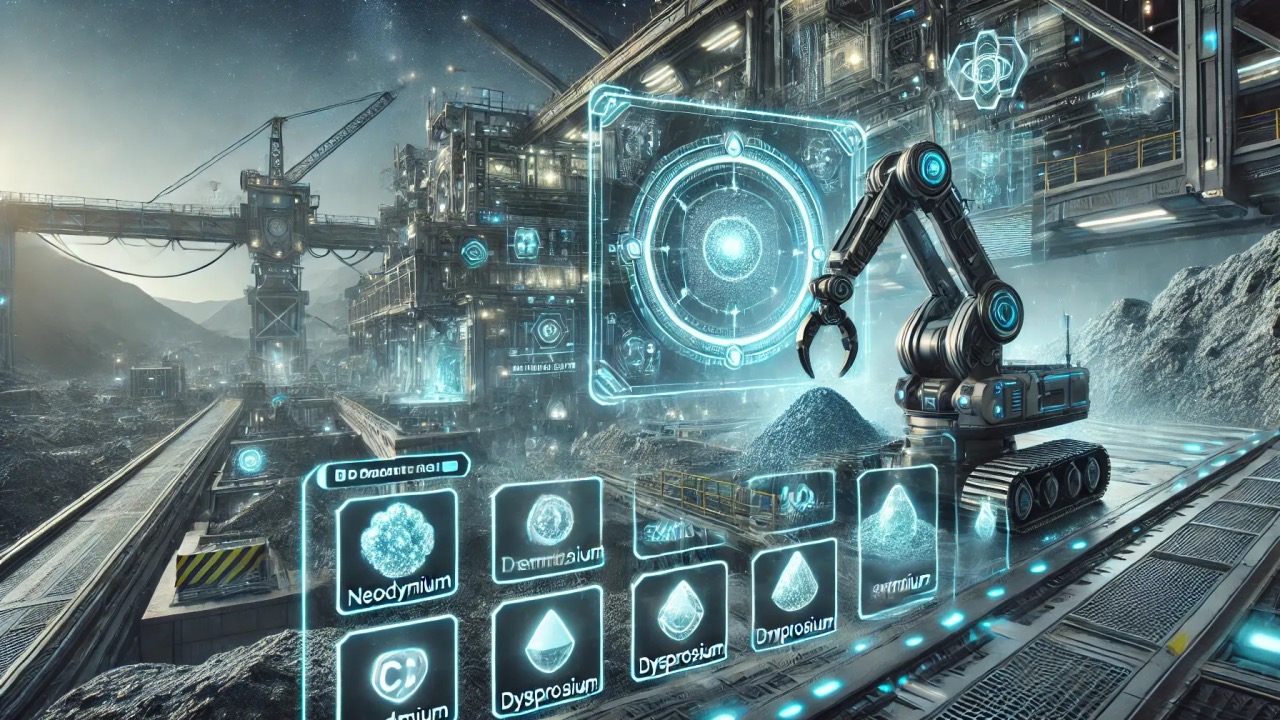
From electric vehicles to wind turbines, and from data centres to advanced manufacturing, one small but critical component sits at the heart of our green and digital future: the permanent magnet. Today, the industry standard is the neodymium-iron-boron (NdFeB) magnet, whose performance depends heavily on neodymium (Nd), praseodymium (Pr), and dysprosium (Dy), with terbium (Tb) used in certain high-temperature applications. These rare-earth-based magnets power EV motors, turbine generators, robotics, hard drives, and more, yet they come with serious sustainability, supply-chain, and geopolitical risks.
This article makes two related arguments. First, artificial intelligence is dramatically accelerating the discovery and optimisation of magnets that use little or no rare earths. Second, from a strategic and investment perspective, especially for climate-tech and defence-tech investors, this represents a once-in-a-generation opportunity. In the near term, recycling will serve as a critical bridge while AI-designed materials move toward industrial scale.
Why are Rare-Earth-Free Magnets a Sovereignty & an Environmental Imperative?
High-performance permanent magnets are essential to both the digital economy and the green energy transition. Data centres depend on precision motors with compact, high-coercivity magnets. Electric vehicles use NdFeB magnets to deliver the high torque density required for efficient motor performance. Wind turbines, both onshore and offshore, use them in direct-drive generators. In robotics and aerospace applications, these magnets enable rapid response times, weight reduction, and precise control. Yet the rare-earth supply system underpinning these technologies is becoming increasingly unsustainable.
Supply & Demand Gap
Multiple studies point to a fundamental mismatch between rare-earth demand and current production capacity. The global NdFeB permanent magnet market is projected to grow from approximately US$30.5 billion in 2024 to nearly US$59.7 billion by 2034 (Zoting, 2025). Upper-bound projections estimate that a complete clean-energy transition involving wind power, electric vehicles, and related infrastructure would require approximately 1,142,850 tonnes of neodymium alone. In 2018, global neodymium production was only about 23,900 tonnes per year. At that rate, it would take roughly 48 years just to meet this single buildout requirement (Ghorbani et al., 2024). Similar long-term shortfalls exist for dysprosium, praseodymium, and terbium (Ghorbani et al., 2024). Put simply, the total material needed for one full generation of green and defence infrastructure far exceeds what current annual production can supply.
This gap is not temporary or cyclical. It is structural, meaning that even with new mining projects and expanded recycling programs, demand could persistently outpace supply. This is precisely why REE-free or REE-reduced magnets and circular economy strategies are not just short-term fixes but essential long-term solutions.
Geopolitical & National Security Risk
China maintains overwhelming control over the rare-earth magnet supply chain. According to the U.S. Department of Energy (2022), China controls approximately 89% of rare-earth oxide separation capacity, 90% of refining operations, and 92% of permanent magnet manufacturing. Independent estimates suggest that 85 to 90% of all NdFeB magnets are currently produced in China (Rare Earth Exchanges, 2025).
This concentration creates acute strategic vulnerability, particularly for defence applications. Permanent magnets are core components in F-35 fighter jets, Virginia-class submarines, Tomahawk missiles, radar systems, and drone motors. Because the Pentagon saw U.S. dependence on China for magnets as a serious national-security problem, it did something it had never done before by buying a $400 million ownership stake in MP Materials, the main U.S. rare-earth mining and magnet company. This landmark public-private partnership funds the construction of the 10X Facility, a 10,000-tonne-per-year magnet manufacturing plant explicitly designed to serve both defence and commercial markets. Expected to reach full capacity by 2028, this facility represents the first time the DoD has taken direct ownership in a rare-earth company, underscoring that the U.S. government considers magnet independence a strategic imperative (MP Materials, 2025).
By securing domestic midstream production, including separation, refining, and magnet manufacturing, the U.S. aims to reduce dependence on China’s vertically integrated supply chain. For investors, this creates a unique dynamic: companies developing AI-designed rare-earth-free materials are not merely participating in a commodity market. They are building a strategic industrial ecosystem with guaranteed government demand, dual-use applications, and national security premiums built into pricing.
Environmental & Climate-Tech Imperatives
Rare-earth mining and refining are energy-intensive, water-intensive, and often highly polluting, involving acid leaching, tailings ponds, and potentially radioactive by-products. All stages of REE extraction, processing, and manufacturing contaminate groundwater, soil, and air, with waste streams frequently released into the environment through informal and illegal operations (Balaram, 2019). These waste streams can contain substantial proportions of radionuclides such as uranium and thorium, which pose environmental and human health hazards (Talan and Huang, 2022). The high energy consumption and greenhouse gas emissions associated with rare earth mining and REO processing further undermine the sustainability of downstream products such as permanent magnets (Binnemans et al., 2013; Kullik, 2019). Life-cycle assessments (LCAs) consistently show that conventional REE production has significantly higher emissions, toxicity, and resource use than circular or alternative routes (Ghorbani et al., 2024).
Therefore, reducing reliance on Nd, Pr, and Dy through novel materials or recycling is fundamentally a green-tech strategy, not just a strategic one.
How Recycling can partially & transitionally help to bridge the gap?
Rare-earth-free magnets will not reach industrial scale immediately, making recycling a vital bridge to ease supply-chain pressure and reduce environmental impact. Yet the actual recovery of rare earth elements through recycling stays remarkably low, as less than 1% was reclaimed in 2011 (Binnemans et al., 2013).
Short-Loop vs Long-Loop Recycling
Two distinct recycling strategies have emerged, each with different trade-offs. Short-loop recycling reuses magnet alloys directly with minimal chemical processing, making it relatively low in energy consumption and cost. However, this approach yields lower-purity materials suitable primarily for non-critical applications such as consumer electronics or low-grade motors (Binnemans et al., 2013; Yang et al., 2016).
In contrast, long-loop recycling involves complete chemical separation and purification of rare-earth elements, including neodymium, praseodymium, and dysprosium. This produces high-purity materials comparable to virgin rare-earth oxides. While long-loop recycling is more complex and energy-intensive than short-loop methods, life-cycle assessment studies demonstrate that it substantially reduces greenhouse gas emissions, toxicity, and overall environmental burden compared to primary mining operations (Ghorbani et al., 2024; Binnemans et al., 2013).
Why Recycling Matters for AI Innovation and Investors
Recycling plays a critical role in supporting AI-driven magnet innovation. While AI facilitates the development of rare-earth-free magnets, high-purity materials remain necessary for laboratory validation and pilot-scale production. Recycling recovers these elements from end-of-life motors, electronics, and magnets, providing a cost-effective and sustainable alternative to primary mining (Yang et al., 2016). For investors, it offers three main advantages: immediate revenue from recovered materials, enhanced supply-chain resilience, and a reliable feedstock for scaling AI-designed magnet technologies. In this way, recycling bridges current supply limitations with future innovation while delivering financial, strategic, and environmental benefits.
While recycling addresses immediate supply constraints, AI is simultaneously solving the longer-term challenge: designing magnets that eliminate rare-earth dependence.
How AI is Accelerating Rare-Earth-Free Magnet Innovation?
AI is compressing what used to take decades of materials R&D into months. Here are four complementary methodologies reshaping discovery. Below, I explain each AI-driven approach.
1. Machine Learning for Property Prediction
Machine learning is transforming the discovery of magnetic materials by analysing historical datasets of known alloys, including their composition, crystal structure, microstructure, and measured properties such as coercivity, remanence, and Curie temperature (Bhandari et al., 2024). Advanced models, including graph neural networks and gradient boosting algorithms, capture complex relationships between these features and magnetic performance. This allows researchers to predict the properties of untested or hypothetical materials, reducing the need for labour-intensive trial-and-error experiments. By focusing on the most promising candidates, scientists can significantly accelerate the development of rare-earth-free magnets (Xia et al., 2022).
2. High-Throughput DFT + Active Learning
AI also guides density functional theory (DFT) simulations across large chemical composition spaces, such as iron combined with multiple other elements. Active-learning strategies enable the model to select which compositions to simulate next to maximise information gain (Singh et al., 2022). This approach identifies novel systems that may not occur to human researchers, including Fe-rich or Mn-based alloys with high theoretical performance. By systematically ranking the top candidates, thousands of potential materials can be narrowed to a manageable number for experimental validation. Integrating physics-based simulations with machine learning ensures that predictions are both theoretically sound and experimentally feasible, greatly accelerating the research timeline.
3. Generative AI for Novel Magnet Formulas
Generative AI models, such as variational autoencoders and diffusion-based networks, are capable of creating entirely new chemical compositions and crystal structures that do not exist in current materials databases. This expands the search space far beyond what conventional methods or human intuition can achieve. By exploring previously uncharted alloys, these models accelerate the design of high-performance rare-earth-free magnets and reduce the time from conceptualisation to laboratory testing (Merchant et al., 2023).
4. Physics-Informed Neural Networks (PINNs)
Physics-Informed Neural Networks (PINNs) incorporate fundamental physical laws, including thermodynamics, magnetism, and crystal-field theory, directly into the AI models (Michaloglou et al., 2025). This ensures that predicted materials are physically realistic, stable under standard conditions, and manufacturable. PINNs help prevent the generation of impractical candidates, such as magnet phases that only exist at extremely low temperatures. When combined with high-throughput simulations and generative AI, these models create a closed-loop system that accelerates the identification of functional rare-earth-free magnets and enables practical experimental validation.
Conclusion
AI is starting to transform the critical magnets industry, creating two clear investment opportunities. First, AI discovery platforms develop software tools that accelerate the design of new magnetic materials. These companies can scale quickly and generate high margins, as their value lies in technology and intellectual property rather than manufacturing. Second, manufacturers producing AI-designed magnets focus on scaling these materials into commercial products. Thanks to improved performance, they can charge a premium and often benefit from long-term contracts or government agreements that make revenue more predictable. Together, these areas highlight how AI is reshaping both the innovation and production sides of critical magnets, offering investors multiple ways to participate in this emerging market.
For investors in climate tech, advanced manufacturing, or defence, this moment matters. The shift to rare-earth-free magnets is not just about better materials. It is about supply-chain security, environmental sustainability, and strategic independence converging in a single market opportunity. If AI-designed rare-earth-free magnets capture even 10% of the NdFeB market by 2034, that would represent roughly $6 billion in annual sales, a twentyfold increase from today’s nearly nonexistent market share (Zoting, 2025). Companies that move early into this space are likely to command premium prices. Because these magnets eliminate dependence on Chinese supply chains and serve both commercial and defence markets, customers will pay more for supply security. When you combine rapid market growth with strategic necessity and limited early competition, the result is an unusually favourable risk-return profile for investors willing to enter now.
References
Rare Earth Exchanges. (2025, November 17). Rare Earth Magnets: Sintered vs. Bonded and the Global Tug-of-War for Control. https://rareearthexchanges.com/news/rare-earth-magnets-sintered-vs-bonded-and-the-global-tug-of-war-for-control/
Ghorbani, Y., Ilankoon, I.M.S.K., Dushyantha, N., & Nwaila, G.T. (2024). Rare earth permanent magnets for the green energy transition: Bottlenecks, current developments and cleaner production solutions. Resources, Conservation and Recycling, 205, 107966. https://doi.org/10.1016/j.resconrec.2024.107966
U.S. Department of Energy. (2022). 2022 critical materials assessment. Office of Energy Efficiency and Renewable Energy. https://www.energy.gov/sites/default/files/2023-07/doe-critical-material-assessment_07312023.pdf
MP Materials Corp. (2025). MP Materials Announces Transformational Public Private Partnership with the Department of Defense to Accelerate U.S. Rare Earth Magnet Independence. https://mpmaterials.com/news/mp-materials-announces-transformational-public-private-partnership-with-the-department-of-defense-to-accelerate-u-s-rare-earth-magnet-independence/
Balaram, V. (2019). Rare earth elements: A review of applications, occurrence, exploration, analysis, recycling, and environmental impact. Geoscience Frontiers, 10(4), 1285-1303. https://doi.org/10.1016/j.gsf.2018.12.005
Talan, D., Huang, Q., Liang, L., & Song, X. (2022). Conceptual Process Development for the Separation of Thorium, Uranium, and Rare Earths from Coarse Coal Refuse. Mineral Processing and Extractive Metallurgy Review, 44(5), 330–345. https://doi.org/10.1080/08827508.2022.2064855
Binnemans, K., Jones, P. T., Blanpain, B., Van Gerven, T., Yang, Y., Walton, A., & Buchert, M. (2013). Recycling of rare earths: a critical review. Journal of Cleaner Production, 51, 1–22. https://doi.org/10.1016/j.jclepro.2012.12.037
Reck, B. K., & Graedel, T. E. (2012). Challenges in metal recycling. Science, 337(6095), 690–695. https://doi.org/10.1126/science.1217501
Yang, Y., Walton, A., Sheridan, R., Güth, K., Gauß, R., Gutfleisch, O., Buchert, M., Steenari, B., Van Gerven, T., Jones, P. T., & Binnemans, K. (2016). REE Recovery from End-of-Life NdFeB Permanent Magnet Scrap: A Critical Review. Journal of Sustainable Metallurgy, 3(1), 122–149. https://doi.org/10.1007/s40831-016-0090-4
Bhandari, C., Nop, G. N., Smith, J. D., & Paudyal, D. (2024). Accurate machine-learning predictions of coercivity in high-performance permanent magnets. Physical Review Applied, 22(2). https://doi.org/10.1103/physrevapplied.22.024046
Xia, W., Sakurai, M., Balasubramanian, B., Liao, T., Wang, R., Zhang, C., Sun, H., Ho, K., Chelikowsky, J. R., Sellmyer, D. J., & Wang, C. (2022). Accelerating the discovery of novel magnetic materials using machine learning–guided adaptive feedback. Proceedings of the National Academy of Sciences, 119(47), e2204485119. https://doi.org/10.1073/pnas.2204485119
Singh, P., Del Rose, T., Vazquez, G., Arroyave, R., & Mudryk, Y. (2022). Machine-learning enabled thermodynamic model for the design of new rare-earth compounds. Acta Materialia, 229, 117759. https://doi.org/10.1016/j.actamat.2022.117759
Merchant, A., Batzner, S., Schoenholz, S. S., Aykol, M., Cheon, G., & Cubuk, E. D. (2023). Scaling deep learning for materials discovery. Nature, 624(7990), 80–85. https://doi.org/10.1038/s41586-023-06735-9
Zoting, S. (2025, August 12). NDFEB Permanent Magnets market size to hit USD 59.74 billion by 2034. https://www.precedenceresearch.com/ndfeb-permanent-magnets-market
Michaloglou, A., Papadimitriou, I., Gialampoukidis, I., Vrochidis, S., & Kompatsiaris, I. (2025). Physics-Informed Neural Networks in Materials Modeling and Design: A review. Archives of Computational Methods in Engineering. https://doi.org/10.1007/s11831-025-10448-9