Rose Kozak, for Bombellii Ventures
Every forecast of the next decade has the same two curves climbing: the number of autonomous machines, and the energy it takes to run them. Robots are moving off the factory floor and onto construction sites and the seabed. Teams of AI agents are multiplying inside insurers, retailers, and builders. The data centers behind them are on track to draw more power than most countries use. Both of those curves are usually treated as settled. Coordinating the machines well will move both.
For most of their history these machines were rare and solitary. Now they arrive in numbers. This is the familiar arc of an industrial transition. Capability comes first, building a machine that works at all. Coordination comes next, making many work as one, and it becomes the constraint exactly when the machines grow numerous enough to deploy at scale. That is where we are now.
The coordination layer will decide where the value in the next decade of automation lands and how much energy the whole system burns to do its work. Today most investment flows to the machines themselves, and most of the energy conversation treats rising demand as fixed. The layer in between, the infrastructure that lets independent machines coordinate, is where value is quietly moving.
Connecting machines is becoming free: the protocols they connect through, MCP and A2A, were handed to the Linux Foundation in 2025. Coordinating them is becoming the business, and building that layer well is one of the rare investments that pays in both returns and carbon saved.
Coordination becomes the business
I have spent a long time fascinated by how groups act together without anyone in charge. Consensus comes from a shared understanding of the world, and movement is fluid and uninterrupted.
An ant colony is the clearest case. Thousands of ants build and feed a city underground with no manager and no meeting. Each ant follows a scent the others left behind, and the trail in the soil carries what the next ant needs to know. Biologists call it stigmergy, coordinating through the environment instead of through messages. The meaning left behind is the message.
Machines are starting to do the same. We built our first fleets and agent teams to coordinate the way people do, by passing messages back and forth, and today most of that coordination still runs through people, on tools built for human eyes and voices. A construction site coordinates its machines with the foreman’s radio, the vendor’s dispatch console, and the schedule in a spreadsheet. An agent stack coordinates with an orchestrator and a chat channel where someone watches the agents work. Each channel ends at a person, so machines coordinate only as fast as the people relaying for them. The same three failures repeat wherever fleets grow. Every vendor ships its own dispatcher, so two vendors on one site means two control systems that do not coordinate. Plans are written per machine, so the coordination effort grows faster than the capacity it buys. And the links die where the work is hardest, under the ocean, past mine portals, inside steel-framed buildings.
One question collapses the failures into a single fact. When two machines claim the same piece of work, what settles it? Six answers exist.

Moving across the answers, the arbiter gets cheaper and easier to audit, and every failure above lives in the first four. A machine does not have to coordinate like a person. Its state is legible from the outside and updates in real time, so instead of sending a message about what it is doing, it can write that state straight into a shared record that every other machine reads. A message is consumed the moment it is read; the record accumulates, and every write makes it worth more. Coordination stops being a conversation and becomes a place.

The internet is the recent precedent. The protocols that let computers reach each other, TCP/IP and HTTP, were given away for nothing, and the value moved to the hardware every packet crossed. Cisco owned the routers every network connected through, and it grew into one of the most valuable companies of its era. The barcode made the same move a decade earlier. The standard was open, free for any store to adopt, and the value settled on the scanners and the scan data they produced. When connection becomes free, the money gathers around whatever accumulates and whatever everything must integrate to.
Machines are now at that moment. How they connect and pass messages is becoming standard and free. The record of the work, the living account of what each machine is doing and what comes next, cannot be given away, and that is where the value is moving.
Opportunity
The record is the asset worth owning, the shared, validated account of the work that every machine reads from and writes to. On a construction site it is the live model of the building that each vendor’s robot updates, so a layout robot and a drilling robot stop colliding and start taking turns. In a data center it is the shared state a team of AI agents works against instead of talking over one another. Whoever holds that record becomes the point every new machine plugs into, and the record grows more valuable with every machine that joins and every day of history it keeps.
The record is powerful because everything else gathers around it. The format machines agree to speak, the identity each one carries, the proof a regulator or an insurer eventually asks for, all of it accrues to whoever holds the record, because the record already knows who did what. Answer who is allowed to act and whether the work can be proven from the same place the work is written, and a single product does what would otherwise be split across separate tools.
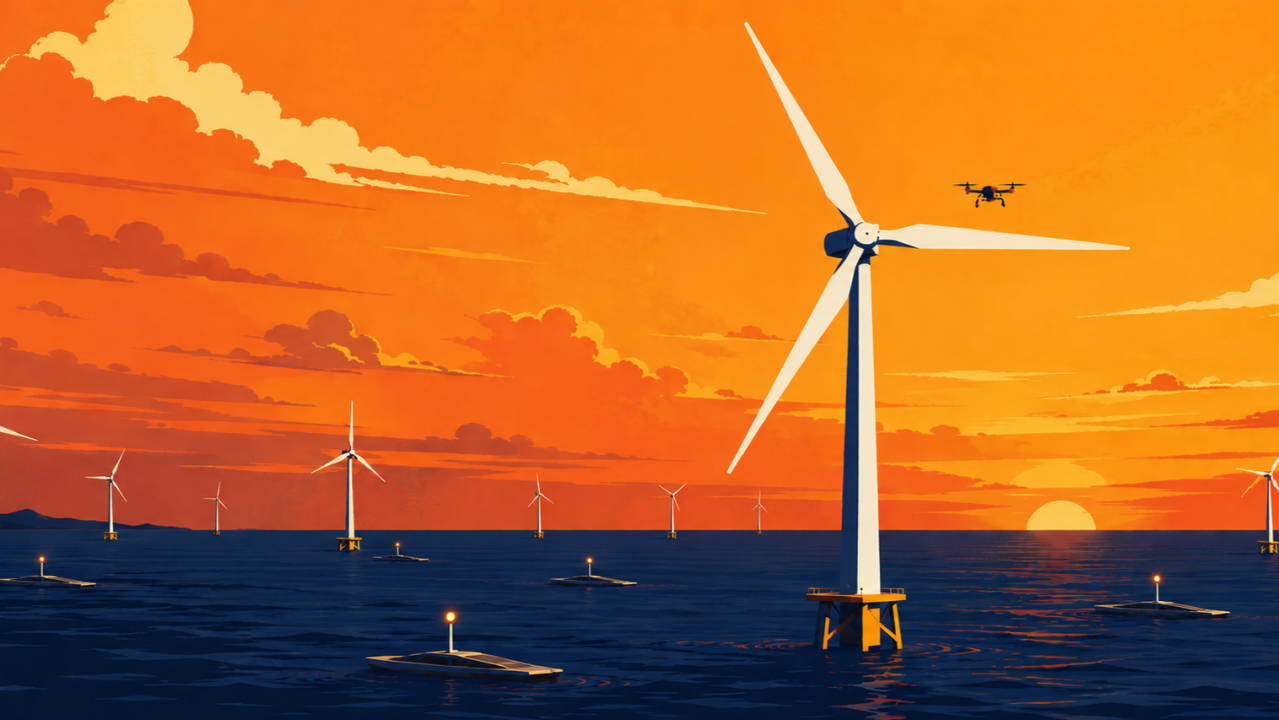
The first setting is underwater. Radio does not reach the seabed, and every offshore wind farm and subsea pipeline needs constant inspection. Companies like Hydromea and WSense are building the way a fleet of resident robots shares what it finds without a network to carry it. Most of the power waiting to come online is wind, solar, and storage, so how fast the energy transition gets built depends on how fast fleets of machines can install it and keep it running. Coordinate those fleets well and the same work gets done with fewer machines and fewer wasted passes. An offshore wind farm inspected by a fleet that lives on the seabed no longer needs the crewed support ship that burns fuel by the ton for every day it is out.
The second setting is regulated work, where someone will eventually have to prove what the machines did. When a drone flies beyond its operator’s sight or a robot works alongside people, an insurer underwrites it and a regulator signs off, and both want an account they can trust. The record is that account, produced as the work happens rather than reconstructed afterward. New rules keep making the demand concrete. The FAA has proposed opening routine flight beyond an operator’s line of sight to drones, a rule moving through review since 2025, and the updated international safety standard for collaborative robots, ISO 10218, took effect in 2025. OneTrust is the software precedent for how fast this kind of market forms. It grew into a reported hundred-million-dollar business in about three years by selling companies the proof GDPR suddenly demanded. The same record cuts the energy bill of the software it coordinates. Every message an AI agent sends costs electricity. In one benchmark a team of agents working from one shared record used about an eighth of the tokens of a team coordinating by messages, and finished nearly three times the tasks.

Multiply that by the scale coming. A single AI prompt draws roughly a quarter of a watt-hour today, and data centers are projected to pull about 945 terawatt-hours a year by 2030, near the total electricity use of Japan. More agents are coming either way. The coordination layer sets the electricity behind each unit of their work, and in the benchmark above a shared record cut it by seven-eighths.
The market is already visible, before the winning version of the record even exists. Middleware, system integration, and the working world’s radio channels are together worth tens of billions of dollars a year, and almost all of it exists to bridge machines that cannot share a plan. Give them a shared record and that work relocates onto it. Meanwhile the money is pointed the other way. Over the past year, more than three-quarters of the capital going into physical AI went to the machines themselves, the models and the robots, while the software that coordinates them drew almost none of it. Demand is arriving faster than anyone is funding the layer that has to carry it.

This is a newcomer’s job, because the record has to be neutral. A record that every vendor writes to must belong to no vendor. The company that makes the robots wants you on its own system, and the platform wants you inside its walls. Only a party with nothing of its own to protect can hold the record where all of them can reach it.
The one I want to build toward
I am drawn to this because of how I am wired. More than almost anything, I love finding two groups who want the same thing and cannot quite hear each other, and helping them see they have been saying it in different words. That is what this shift is. A submarine builder and an AI lab look like they share nothing. They are stuck on the same problem, and the answer the ants found is the one they both need.
The company I am looking for already talks in the record’s language: shared state, validated writes, replay. A rival vendor’s machine can join it, and when two machines claim the same piece of work, the record settles it.
Connecting machines is becoming free. Coordinating them is becoming the business. The record of the work is the place to stand, the one that grows more valuable the more the world leans on it, and lighter on the planet as it does. This is one of the few infrastructure choices a generation gets to make before the scale arrives instead of after, and it sets how much the automation era is worth and how much energy it burns to run. The machines are learning to thrive by reading their environment. So are we.
Appendix: for the curious
Measured, built, proven. Dialogue is expensive in software. It has been measured, in agent teams that hit diminishing returns on messaging, where past a low rate more conversation costs more and helps less. It has been built, in systems like PatchBoard that share one state instead of messaging and beat the messaging baselines at a fraction of the tokens. And it has been proven, in formal-methods work that verifies guarantees over a swarm’s shared state, like no two agents ever claiming the same task, the assurance a certifier or insurer can accept. Sources below.
Why the record splits into two products. A shared record kept across machines that lose contact must choose, during an outage, between refusing new writes (correct but frozen) and writing locally then merging (moving but briefly out of sync). This is the CAP theorem. Subsea fleets, which lose the link daily, need the second; audited enterprise work needs the first. That is why the physical and software versions of the record will be built by different companies.
Shared convention, the mechanism the body leaves out. A fleet can also coordinate through convention, one policy trained into every machine beforehand, the way traffic rules and flocking work. Convention is free at runtime and handles only what training anticipated; a discovery made mid-run has no channel to travel. It accumulates nothing, so the durable value sits with whoever trains the policy, and a standard is a convention someone owns.
The durability test, and why the record rather than the pipe. A layer lasts when it accumulates state, everything integrates to it, and its value sits in what the standard leaves unspecified. The internet’s winners fit: Cisco, the router everything connected through, and VeriSign, the registry every domain clears through, endured; the Ethernet-card maker 3Com, whose product an open standard fully specified, was commoditized. The record fits the durable pattern; the raw connection does not.
What to look for in a company here. Words that fit: system of record, shared state, vendor-neutral, replay, validated writes. Words that do not: orchestrator, dispatcher, message bus, single-vendor fleet management, dashboard. One question decides it. When two machines claim the same task, what settles it? A validated record is the right answer; a controller, or “they talk it out,” is not.
Sources
Figures appear plainly in the text; here is where each comes from, current as of July 2026.
- Data centers on track to about 945 terawatt-hours a year by 2030 — IEA, Energy and AI (2025), base-case scenario, roughly a doubling of 2024 demand.
- A median AI prompt draws about a quarter of a watt-hour — Google, Measuring the environmental impact of AI inference (2025); a median text prompt, and a figure that is falling quickly.
- A shared-record team used about an eighth of the tokens and finished nearly three times the tasks — PatchBoard (arXiv:2605.29313, Xidian University, 2026): 84.6 percent versus 30.8 percent task success, 45.5k versus 368.3k tokens per successful task, against a message-passing baseline.
- More than three-quarters of physical-AI capital went to models and robots — New Market Pitch disclosed-deal dataset (77.6 percent, August 2025 to July 2026); a single tracker, so directional.
- Middleware and system integration in the tens of billions a year — industrial system integration about $47B (Mordor Intelligence; The Business Research Company); land mobile radio above $20B (Grand View Research; MarketsandMarkets).
- OneTrust reached about $100 million in roughly three years — reported revenue (Contrary Research; Forbes); founded 2016, GDPR in force May 2018.
- The updated collaborative-robot safety standard, ISO 10218, took effect in 2025 — ISO 10218-1 and -2:2025 (United States: ANSI/A3 R15.06-2025).
- The FAA’s proposed rule for routine beyond-line-of-sight drone flight — FAA Part 108 notice of proposed rulemaking (2025), still in rulemaking.
- Wind emits about 11g CO2 per kWh against roughly 450 to 490 for gas; a gigawatt of offshore wind generates about 4 TWh a year and avoids on the order of 2 million tonnes of CO2 versus gas — NREL (wind lifecycle; harmonized gas about 450g), IPCC AR5 (gas 490g); capacity factor near 46 percent.
- The open protocols moved to the Linux Foundation — A2A (June 2025) and MCP (December 2025, via the Agentic AI Foundation).
Research threads: Kim et al., Towards a Science of Scaling Agent Systems (arXiv:2512.08296); Han and Zhang, blackboard architecture (arXiv:2507.01701); Pinciroli and Beltrame, virtual stigmergy in the Buzz swarm language; De Nicola and colleagues (IMT Lucca and the Gran Sasso Science Institute), formal verification of stigmergic task allocation; Harvard’s TERMES robots, which build with no messages at all (Science, 2014).