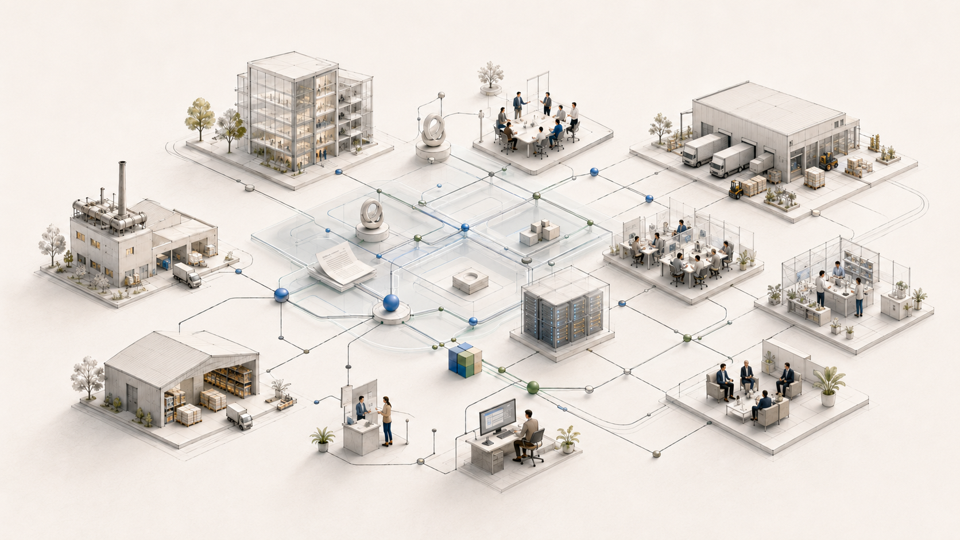
Why company context and continually improving agents will create a new operational control plane
By Gaby Cornejo, For Bombellii Ventures
Why Enterprise AI Still Struggles to Learn the Business
Businesses generate rich operating context every day: the judgment, exceptions, and outcomes that explain how work actually gets done. It lives in customer conversations, internal policies, operating systems, and the small decisions that keep work moving. This may be the most valuable information a company owns, yet general AI models do not naturally understand why one customer receives an exception, how a team handles an unusual risk, or which past decision should guide the next one.
That gap helps explain why enterprise AI adoption has moved faster than enterprise AI value. IBM found that only 25% of AI initiatives had delivered their expected return and just 16% had scaled across the enterprise. McKinsey similarly found that only 39% of organizations could point to an enterprise-level earnings impact from AI.
The current response is increasingly human-heavy. Applied AI engineers and deployment teams sit with customers to understand how the business works and translate its processes and edge cases into tailored systems. Anthropic went so far as to help form a new enterprise AI services company in 2026 to provide this kind of hands-on implementation and help enterprises realize more value from AI. The approach reflects how important this work has become, but bespoke implementation is expensive and difficult to scale.
A new infrastructure category can automate that translation. Businesses are beginning to build context graphs, which capture how their decisions are made, while agents are beginning to improve from production experience. Together, these changes create the need for a control layer that records what was learned, decides where each lesson should live, and verifies that the change improved outcomes. We call this emerging category Continual Learning Operations. To understand why it is needed, it helps to look first at the two forces creating it: context graphs and continual learning.
Context Graphs Make the Business Legible
A context graph is a living map of how a company makes decisions. It connects the information considered with the action that followed and the result that came afterward. A normal database may show that a discount was approved. A context graph can also show why it was approved, which policy applied, who had authority, and whether the decision worked.
That distinction matters because useful company knowledge is rarely a clean set of rules. It depends on timing, relationships, past outcomes, and judgment. Context graphs preserve those connections so an agent can act with a clearer picture of the business instead of retrieving a related document without understanding the decision around it. Seed-stage Context and a July 2026 paper proposing live context graphs for proactive enterprise agents point toward this richer enterprise context layer.
The graph also cannot remain static. Policies change, customer behavior shifts, and a decision that once worked can become poor guidance. Context graphs therefore create more than a retrieval problem. Their changing lessons must be carried safely into the agents that use them.
Continual Learning Makes Improvement Persistent
Most AI systems today are trained, tested, and then deployed. Once in production, they do not keep learning from the cases they encounter and adapting them usually requires another round of training or fine-tuning. Continual learning allows a system to learn incrementally as new data and tasks arrive while preserving what it has already learned. It is designed for a world where customer behavior, business rules, and operating conditions do not stand still.
For an agent, the practical question is where a new lesson should go. Memory can hold a changing fact, while context and prompts can refine what the model sees and how it is instructed. Skills and tools add reusable capabilities; the harness or workflow changes how the agent plans, checks, and completes its work. Adapters and model weights alter broader behavior inside the model itself. These are different behavioral substrates, or parts of the agent that shape what it does, and the range is expanding as agent systems become more modular.
Because these layers differ in speed and reach, no one method is right for every lesson. Learning should land in the lightest effective layer, with fast-changing knowledge kept near the surface and deeper model changes reserved for broad, stable patterns. Using several methods allows an agent to improve more precisely while remaining easier to inspect, correct, and operate.
The Missing Control Layer
Continual Learning Operations can supply that missing control plane between company experience and agent behavior, with three connected jobs. A learning ledger preserves the paper trail: which event produced a lesson, where it was stored, and which later decisions used it. A learning router decides where the lesson should land across the agent. A validation layer then checks whether the update improved real outcomes and keeps a path to reverse it if it did not.
This control is essential because repetition does not automatically equal good practice. The same pattern could reflect a sound policy, a temporary workaround, or a mistake that became routine. Before carrying it forward, the system must consider who made the decision, what happened afterward, and whether the surrounding conditions still apply.
Consider a health-insurance claims agent that denies a claim because a required medical record has not arrived, even though the claim should remain open while the record is pending. If adjusters repeatedly reverse those denials after the document arrives, the pattern likely means the agent is deciding too early, rather than that it should approve more claims. The control plane can update the workflow to check for pending records, replay past claims, and confirm that the change reduces premature denials without approving invalid ones. Human corrections become a safe, reusable improvement.
This is also a direct route to enterprise ROI. The control plane automates much of the repetitive work now performed by deployment teams and places each improvement in the lightest effective layer. Companies can get more value from the same models, tools, and data without allowing customization costs to rise with every new agent or workflow. Gartner expects more than 40% of agentic AI projects to be canceled by the end of 2027 because of rising costs, unclear business value, and inadequate risk controls. A learning control plane directly targets those weaknesses by improving outcomes, containing customization costs, and making changes easier to govern.
Where the Stack Is Still Open
The opportunity for founders is visible, but fragmented. RELAI and Trajectory turn production feedback into proposed and tested updates. Belvedir is exploring repeated improvement across memory and model weights, while Context supplies company-specific decision data. Research projects fill in other pieces: MemLineage traces learned memories, Sia Agents coordinates changes across the agent’s surrounding software and weights, and Causal Agent Replay asks which step actually caused an outcome.
No early company yet clearly combines company context, a durable learning paper trail, routing across the full agent stack, and outcome validation in one control plane. A platform embedded in the process of approving and deploying agent improvements could develop a strong moat. Every approved update would deepen its understanding of which signals are reliable, which changes improve results, and how learning moves through the enterprise. It could become the system of record for how the company gets smarter.
The surrounding market is large enough to support that category. Gartner’s best-case scenario projects that agentic AI could generate roughly 30% of enterprise application software revenue by 2035, representing more than $450 billion. IDC expects more than one billion active AI agents to execute roughly 217 billion actions each day by 2029, and forecasts that agentic AI will account for $1.3 trillion, or more than 26%, of worldwide IT spending. At that scale, governing how agents learn becomes core operating infrastructure rather than an optional governance feature.
From Learning to Organizational Simulation
The immediate market is controlling how production agents learn. The larger opportunity is to use that accumulated record to build simulation environments grounded in how a specific business operates. These environments could model how teams, policies, dependencies, and constraints interact, allowing companies to test proposed changes before introducing them into live operations.
A proposed procurement rule, for example, could be tested against past suppliers, approval behavior, and operating outcomes. The company could see where the rule is likely to help, where it may create risk, and what should change before people or agents rely on it. TaskWeave, a 2026 research system that simulated a year inside an IT company while preserving hierarchy, task dependencies, and decision history, offers an early example of how AI could model a real organization over an extended period.
Over time, the control plane becomes an experimentation system for the business itself. Agents can learn from simulated outcomes and move only the strongest changes into production. The enterprise gains something more valuable than better memory: a way to rehearse its future.
The Cost of Adaptive Intelligence
This category also has an important climate role. The International Energy Agency expects electricity use from AI-focused data centers to triple between 2025 and 2030. Hardware efficiency and model routing will help, but the way agents learn is another important efficiency frontier.
Today, a small performance issue can lead a team to retrain a model, expand every prompt, or apply broad fixes across the system. A learning control plane can diagnose the actual failure and place a targeted, durable fix in the lightest effective layer. Better learning reduces repeated errors, unnecessary retraining, and the compute consumed by blunt, system-wide updates.
The benefit also reaches the businesses using AI. Company-specific learning can reveal which operating choices work best under different conditions and carry those lessons across sites and teams. In energy, logistics, buildings, and industrial operations, that can steer future decisions toward lower cost and lower resource use. As AI adoption scales, optimizing how systems learn can become as important to decarbonization as optimizing the chips and models they run on.
Conclusion
Every company is already teaching AI how it works. Today, those lessons are scattered across deployment projects, employee corrections, and prompt patches. Context graphs make the experience legible, continual learning turns it into better behavior, and Continual Learning Operations governs the handoff.
For founders, the open opportunity is the infrastructure that makes this process safe and repeatable. For enterprises, it is a path from one-off AI customization to a capability that compounds. The platform that owns this layer can improve business outcomes now and eventually become the system through which an organization learns from its past and tests its future.
Selected Sources and Research
Enterprise Adoption, ROI, and Market Evidence
1. IBM Institute for Business Value. “CEOs Double Down on AI While Navigating Enterprise Hurdles.” May 2025.
2. McKinsey & Company. “The State of AI in 2025: Agents, Innovation, and Transformation.” November 2025.
3. Gartner. “Over 40% of Agentic AI Projects Will Be Canceled by End of 2027.” June 2025.
4. Gartner. “Gartner Predicts 40% of Enterprise Apps Will Feature Task-Specific AI Agents by 2026.” August 2025.
5. IDC. “Agentic AI Is Critical Infrastructure.” March 2026.
Enterprise Context and Deployment
6. Foundation Capital. “AI’s Trillion-Dollar Opportunity: Context Graphs.” December 2025.
7. Kumar, Avinash. “Context Graphs for Proactive Enterprise Agents.” July 2026.
8. Context. “Build, Deploy, and Improve AI Agents.” August 2026.
9. Anthropic. “Building a New Enterprise AI Services Company with Blackstone, Hellman & Friedman, and Goldman Sachs.” May 2026.
10. Anthropic. “Anthropic Invests $100 Million into the Claude Partner Network.” March 2026.
Continual Learning and Agent Systems
11. IBM. “What Is Continual Learning?” August 2026.
12. RELAI. “Introducing RELAI: Verifiable Continual Learning for AI Agents Backed by $6.9M in Funding.” June 2026.
13. Trajectory. “The Platform for Continual Learning.” August 2026.
14. Y Combinator. “Belvedir: The Autonomous Private AI Platform.” August 2026.
15. Karten et al. “Continual Harness: Online Adaptation for Self-Improving Foundation Agents.” May 2026.
16. Hebbar et al. “SIA: Self Improving AI with Harness & Weight Updates.” May 2026.
17. Ouyang and Hou. “MemLineage.” May 2026.
18. Wang et al. “Agentic Unlearning: When LLM Agent Meets Machine Unlearning.” February 2026; Shah. “Causal Agent Replay: Counterfactual Attribution for LLM-Agent Failures.” June 2026.
19. LangChain. “Continual Learning for AI Agents.” April 2026.
20. Zhu et al. “Can LLM Agents Sustain Long-Horizon Organizational Dynamics?” May 2026.
Energy and Climate
21. International Energy Agency. “Key Questions on Energy and AI.” April 2026.