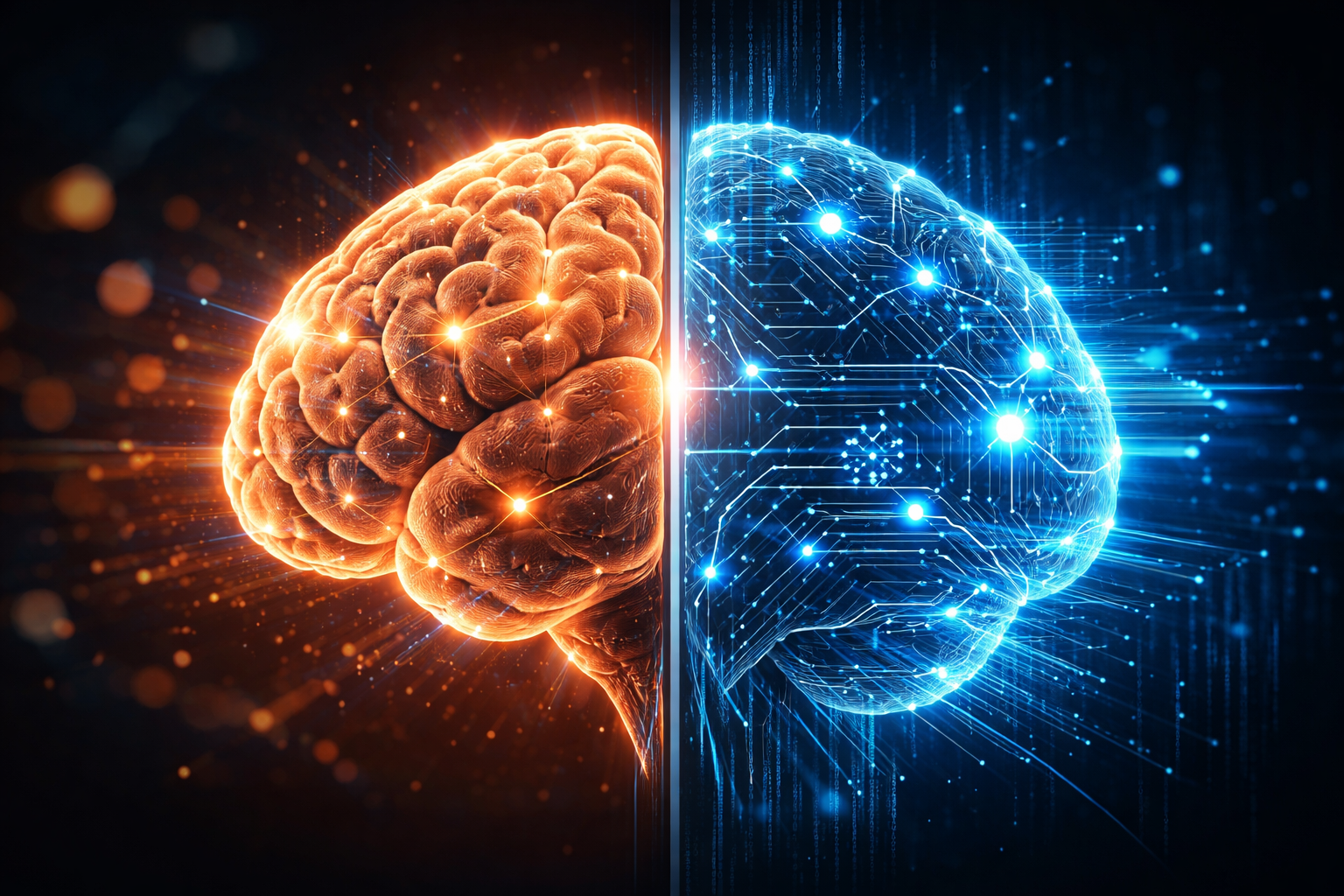
In the past five years, headlines mentioning Artificial Intelligence have skyrocketed: from 110 per day in 2020 to over 2,100 per day in 2025. Alongside this surge, newer terms like AGI (Artificial General Intelligence) and Super Intelligence have entered the conversation, often without the rigor or clarity that science demands.
The striking feature of the AI debate is not only its intensity, but its ambiguity. We speak with urgency about milestones that remain undefined, compare machines to a human capacity we scarcely agree on, and speculate about futures built on economic assumptions we rarely examine.
Do We Even Know What We’re Talking About?
AI “ A Moving Baseline”: Artificial Intelligence is not a single technology but an umbrella term. At its broadest, it refers to computational systems performing tasks that typically require human cognition, from pattern recognition and optimization to language generation and decision support.
The boundary shifts constantly. What was once considered AI (optical character recognition, for example) is now mundane software. AI is less a fixed category than a horizon: it recedes as systems normalize.
AGI “The Elastic Ideal” : Artificial General Intelligence (AGI) is often described as a system capable of performing any intellectual task a human can. Some definitions add autonomous learning, transfer across domains, or even consciousness. There is no scientific consensus.
When executives or commentators ask, “How close are we to AGI?”, they are frequently debating different targets. Without definitional stability, timelines become rhetorical rather than analytical tools.
Superintelligence “The Power Without Parameters”: Superintelligence is described either as superiority across all economically valuable tasks or as intelligence beyond human comprehension. The term evokes inevitability and rupture, yet it lacks operational criteria. It appears regularly in headlines and policy discussions despite its indeterminacy.
Ambiguous concepts are not inherently useless. But when investment, regulation, and public fear orbit undefined thresholds, ambiguity becomes consequential.
AGI vs. Human Intelligence “ A Comparison Without a Map” : The aspiration to build Artificial General Intelligence assumes we understand Human General Intelligence. We do not. Over the past century, human intelligence has been framed in multiple, sometimes conflicting ways: Psychometric intelligence (IQ) (Emphasizing memory, reasoning, and analytical speed), Emotional intelligence (Highlighting empathy, self-regulation, and interpersonal skill), Social cognition (Understanding norms, culture, and group dynamics), Creativity and adaptability (Generating novelty and navigating uncertainty).
Scholars continue to debate whether human intelligence is a single general factor, a constellation of partially independent abilities, or an emergent property of cognition embedded in environment and culture.
If human intelligence itself is unsettled, declaring that machines will exceed it risks conceptual illusion. Surpass which dimension? In what context? By what metric? The comparison often reveals less about machines than about our shifting self-conception.
The Economy of Words and Money
Who owns the AGI Narrative today ? The loudest voices forecasting AGI are often not cognitive scientists but founders, investors, writers and media commentators. Their incentives differ: attention, valuation, strategic positioning. Narrative becomes capital.
Recent funding announcements illustrate how perception can outpace substance. Headlines proclaim enormous commitments, yet closer inspection reveals conditional tranches, compute credits rather than cash, milestone-based releases, and letters of intent. Large numbers signal confidence; fine print signals contingency.
One rumored clause in a major partnership ties funding to reaching “AGI milestone” defined as automating 50% of human productivity tasks, as determined by an independent panel. Even this raises deeper questions: Which tasks? Under what conditions? With what reliability? Measured how?
The language of breakthrough often masks the complexity of measurement.
From the “Capability” Hype to “Reliability” reality: Public discourse celebrates capability: models that write essays, generate images, pass exams, drive vehicles. But in high-stakes domains, capability is insufficient. Reliability (consistent, safe performance under unpredictable conditions) is the true threshold. Companies such as Waymo and Tesla have spent over a decade refining systems that can handle edge cases in dynamic environments. Billions of simulated miles and millions of real-world miles later, supervision and geofencing remain central. The difficulty is not initial success, but robust generalization.
Reliability scales more slowly than capability. It requires redundancy, governance, interpretability, and institutional adaptation. Before asking when machines will become superintelligent, we might ask when they will become predictably dependable.
Toward a More Productive Dialogue : If uncertainty around intelligence is daunting, what can professionals do today to have meaningful discussions?
Firstly, let’s avoid Anthropocentrism. Much fear assumes machines will “want” something or “take over.” As of today, AI has no will, no survival instinct, and no subjective experience. Understanding AI on its own terms rather than projecting human traits anchors discussions in reality.
Secondly, Let’s build a dialogue grounded in precision. We need debates rooted in clarity, humility, and multidisciplinary perspectives: Define terms (Be precise about AI, AGI, and Super Intelligence), Collaborate across disciplines (Ethics, philosophy, economics, and technology).
Rethinking Society: Beyond Labor Scarcity
If AI systems eventually perform a significant share of economically productive tasks, the consequences will be structural.
Modern economies are built on labor scarcity: income flows from contribution; identity flows from occupation. If productive capacity becomes increasingly automated, scarcity may shift. What becomes scarce in abundance? Attention, Trust, Authentic human presence, Meaning. The debate then moves from engineering to institutional design.
Human Specificity in an Age of Infinite Drafts:In a world of near-infinite computational generation: If machines produce endless variations, originality becomes discernment. If systems optimize decisions, judgment becomes ethical orientation. If processes scale globally, responsibility becomes central. If automation reduces transactional interaction, empathy becomes differentiating.
Human value may migrate from execution to direction, from performing tasks to assigning meaning. Speed and memory were never our only strengths. Moral responsibility, contextual awareness, long-term wisdom, and the ability to care about outcomes remain distinctly human dimensions. Whether they remain exclusively human is uncertain; that they remain normatively central is not.
Possible Trajectories :
- Universal Basic Income (UBI): If automation dramatically expands output, distributing purchasing power independently of employment could stabilize consumption and decouple survival from labor. This would redefine the social contract: participation would no longer hinge primarily on employment.
- Redistribution of Time: Rather than eliminating work, productivity gains could shorten workweeks, expand sabbaticals, or enable intermittent retraining. The dividend of automation would be time.
- Revaluation of Human-Centered Roles: Caregiving, teaching, mentorship, and civic engagement resist automation not because they lack value, but because their value lies in presence and relational depth. An abundant economy may elevate what cannot be scaled.
- Stratification Risks: If AI-driven capital remains concentrated, inequality may widen. Technological abundance does not guarantee distributive justice. Governance determines whether productivity becomes shared prosperity or amplified asymmetry.
Conclusion : A Civilizational Inflection Point
AI challenges more than industries. It challenges the architecture of societies organized around productive scarcity. If efficiency approaches abundance, the fundamental question shifts. Not What can machines do? but: How should we organize a society in which productive output expands faster than human purpose?
The discourse on AGI and superintelligence often leaps toward speculative dominance scenarios. The nearer-term transformation may be quieter but deeper: How wealth is distributed? How is contribution defined? How identity is anchored when work is no longer the sole axis of human economic & social value?
In that sense, the AI debate is less about machines surpassing humanity than about humanity redefining itself. When we speak about artificial intelligence, we may ultimately be conducting a more difficult conversation about our economic systems, our institutions, and our understanding of what it means to matter.