Author : Hrushi Nikam
Let’s cut through the noise and the hype: the AI compute crisis is not a simple hardware bottleneck that money can fix; it is a full-blown software catastrophe fueled by waste. We are all dazzled by the digital magic, the large language models that write, create, and reason but we are simultaneously refusing to look down at the wiring. We rarely pause to ask the true, underlying question: What is the real power price of this intelligence, and how fast is its demand draining the global grid? This furious, reckless race to host the next generation of AI is pushing our physical infrastructure beyond its absolute breaking point. Exponential growth is no longer a sustainable trend; it’s now an immediate, escalating collision with the hard limits of power generation, utility grid constraints, and crippling, spiraling operational costs. The illusion of infinite scalability has shattered.
The underlying strategic challenge is clear: we are facing what the industry has termed The Compute Gap. This crisis isn’t just about money; it’s about a colossal financial roadblock. Leading research estimates that the worldwide construction cost (CapEx) required for data centers to keep pace with demand through 2030 will approach an astonishing $6.7 trillion. More than $5 trillion of that is dedicated just to new AI-intensive infrastructure. Simply put, building $7 trillion worth of new concrete and steel is logically and logistically not feasible, especially when facing multi-year delays for grid connections.
The only way out of this infrastructure blockade is to make our current machines infinitely smarter. The answer isn’t more hardware; it’s Computational AI software that makes every single watt count.
Why Your Data Center’s Report Card (PUE) is Lying to You
For decades, the data center industry has been obsessed with Power Usage Effectiveness (PUE), the ratio that measures facility overhead energy (cooling, lighting, etc.) versus the core IT equipment load. You can think of PUE as the report card for the air conditioner.
While a low PUE is essential: Google, for example, reports a best-in-class average of 1.09, meaning they are virtually running on air. PUE has become a misleading measure; it completely misses the most critical and largest factor: how efficiently the servers themselves are actually working?
The Staggering Reality: The IT Load is the Villain
The core IT load (servers, storage, networking) accounts for 60% or more of the power consumption in most facilities. In highly optimized centers, that percentage skyrockets to over 90%.
Therefore, if we can achieve even a 10-15% efficiency gain in the servers – the biggest energy sink, the financial and environmental savings are profound. This approach provides 2 to 3 times greater return on effort compared to incrementally improving cooling (the focus of PUE). We have been fighting the wrong battle.
The Ghost Army: Systemic Waste in the Rack
The biggest failure in data center strategy isn’t the cooling system. It’s the systemic waste hidden within the servers themselves. This is the “Idling Catastrophe”.
In traditional enterprise or non-optimized environments, most servers are lounging around at utilization rates sometimes as low as 12% to 18% of their capacity. Think of it: 85% of your expensive hardware investment is sitting idle, but still consuming power and generating heat as if it were busy. This “ghost army” of underutilized equipment is what contributes directly to the strain on the grid.
The Bizarre Penalty: The Inverse PUE Paradox
The PUE metric presents a significant flaw: it can actually penalize efforts to maximize computational value. For instance, if an operator drastically improves server utilization (e.g., from 15% to 50%) using intelligent software, the PUE score may worsen.
This is because PUE is a ratio of facility power to IT power. Increased server utilization leads to higher IT power (the denominator), which in turn inflates the PUE ratio, making the score appear less favorable. Essentially, the metric discourages efficiency, creating an operational disincentive for the very kind of advancements needed to scale AI.
The AI Multiplier – Four Software Layers to Turn Compute Into Gold
The strategic response to the $7 trillion CapEx challenge is rooted in software innovation, fueled by over $109.1 billion in U.S. private AI investment in 2024 . For forward-thinking leaders, the opportunity lies in deploying these four critical software layers.
Pillar 1: Intelligent Resource Orchestration – The Data Center DJ
This layer acts as the central nervous system of the data center, leveraging AI to manage resources based on real-time needs, like energy cost and grid carbon intensity.
- Demand Matching: AI acts as a smart scheduler, analyzing traffic and dynamically allocating workloads. This prevents energy waste on underutilized gear and ensures that servers are intelligently "packed" – addressing the 12–18% utilization problem directly.
- Carbon-Aware Scheduling: This is a crucial strategic component. Software can align non-urgent tasks (like massive batch training) with the moments when energy is cheapest or, more importantly, greener. This practice, which can achieve approximately 16% cumulative carbon saving over a multi-year period, transforms the data center into a flexible, grid-friendly partner.
Pillar 2: Model & Algorithm Optimization – The Software Shrink
The single most effective way to save power is to shrink the computational work required by the model itself. This is about applying AI to make AI leaner.
- Training Speed Estimation: Think of the countless hours wasted on failed research. AI tools can analyze the training loss curve and predict the model’s end-state accuracy after only 20% of the computation is complete. This allows developers to abort non-viable runs, shaving off about 80% of the compute for failed experiments and conserving massive amounts of energy.
- Compression & Quantization: This means shrinking the size of the numbers inside the model, so they take up less space and require less power to process. Techniques like Quantization and Pruning (cutting off useless connections) can reduce model size by as much as 9 times with only a minor drop in accuracy.
- Data Pruning: Optimization starts with the input data. AI can curate training sets and remove redundant data points, which can reduce the overall data volume by 20–30% without performance degradation.
Pillar 3: Smart Power Capping and Infrastructure Efficiency
This is the fusion of software control and physical efficiency, where algorithms actively prevent hardware from demanding too much power.
- Processor Throttling (The Cascade Effect): Implementing power capping; limiting the power fed to the GPUs and processors (e.g., to 60%–80% of total power) cuts direct energy consumption. More importantly, reducing processor power instantly lowers the thermal output (waste heat), saving energy twice over by reducing the burden on the facility cooling systems. The cooling system sighs in relief.
- Predictive Maintenance: Machine learning algorithms study vast amounts of data to forecast future energy demands and predict equipment failures (like a chiller or an UPS unit). Since the average cost of an outage can top $700,000, avoiding a disaster through foresight enhances operational efficiency and reliability.
The Payday – Turning Waste into Virtual Gigawatts
The investment thesis for computational efficiency is overwhelmingly compelling because it immediately addresses the largest operational cost factor: energy consumption.
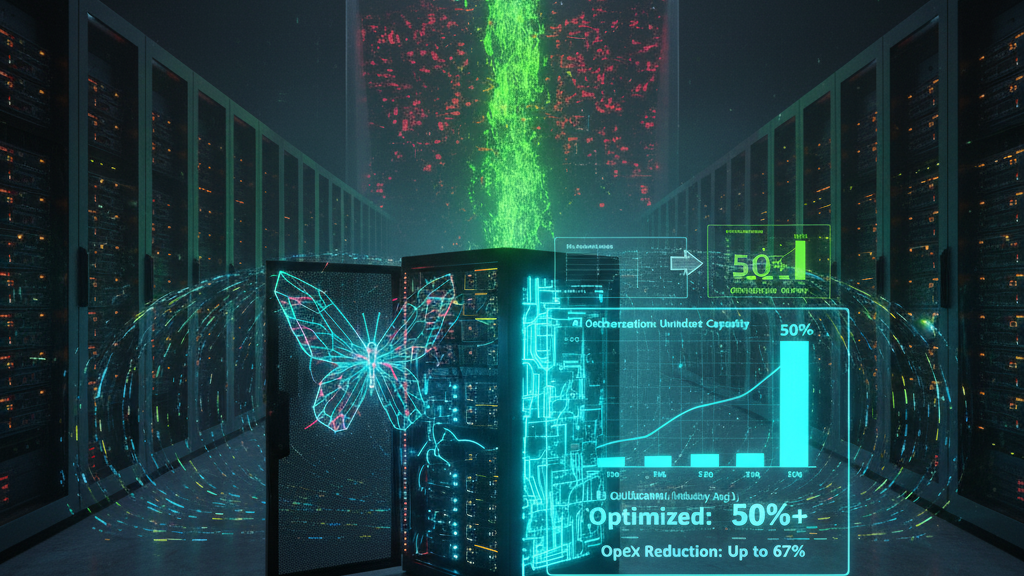
- Massive Financial ROI: The returns are exponential. Case studies show that by intelligently packing workloads, solutions like Sardina Systems” FishOS have helped clients boost server usage from the industry average of 15% to over 50%. This transformation can result in an energy OpEx reduction of up to 67% for the equivalent workload. You turn a 15% slacker into a 50% powerhouse, that is money instantly recognized on the balance sheet.
- Unlocking Stalled Capacity (Virtual Gigawatts): This is the ultimate CapEx avoidance strategy. Because computational efficiency directly reduces waste heat, it instantly lowers the burden on cooling and power systems. This effectively “unlocks” stranded capacity within existing facilities, giving operators “virtual gigawatts” of new compute power that completely bypasses the need for slow, complex, and expensive new grid connections.
- ESG and Grid Synergy: Computational efficiency is the most direct way to reduce a data center’s carbon footprint, supporting global net-zero commitments. Furthermore, intelligent workload orchestration makes the data center a flexible partner for the utility grid, enabling it to defer consumption during peak grid strain and securing national energy stability.
The future of compute is about doing more with less energy. Investing in computational efficiency is not just an opportunity; it is the imperative for scaling AI sustainably and profitably.