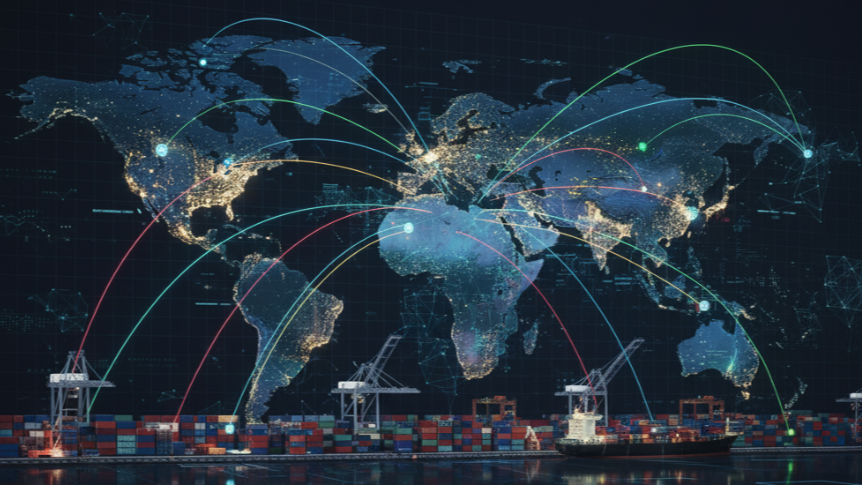
The global container supply chain moves nearly 90 percent of the world’s goods, yet it continues to operate with remarkable inefficiency. Despite its scale and sophistication, the system struggles with deep structural issues. Containers sit idle in ports for extended periods, trucks often drive without loads, and empty equipment is repositioned around the globe at staggering cost. The result is a fragmented ecosystem that wastes time, money, and resources, which costs the global economy more than $20 billion annually.
The Problem: A System Out of Balance
Ports, shipping lines, and inland transport providers all work within their own silos. A shipping line may know where its vessels are, but not which containers sit idle at rail terminals. A port operator can see dwell times rising but lacks data on expected pickups. Trucking firms lose valuable hours waiting for containers buried deep in storage stacks. Each actor optimizes within its boundaries, leaving the broader network uncoordinated.
The numbers paint a stark picture. About 35% of all truck trips in the container supply chain run empty. Global port yards average just 56% utilization despite congestion complaints. Meanwhile, more than 2.5 million containers sit empty around the world waiting to be repositioned, costing the industry upwards of $20 billion a year. Even small breakdowns in coordination cascade across the chain, causing bottlenecks that delay shipments, inflate costs, and increase carbon emissions.
Why It Matters
The inefficiency of the current system affects far more than transportation operators. It drives up consumer prices, increases emissions, and undermines global supply chain resilience. Every unnecessary empty container move contributes to rising fuel consumption and carbon output. Every hour of lost time in port storage inflates logistics costs and capital requirements. Every mismatch between available equipment and export demand creates further strain on trade networks already pressured by geopolitical uncertainty and shifting demand cycles.
The consequences are also strategic. As global trade evolves under the combined forces of nearshoring, energy transition, and climate policy, supply chain inefficiency limits competitiveness. Delays and unpredictability translate directly into lost business and weaker margins. In a sector already constrained by infrastructure and workforce shortages, the need for intelligent optimization has become urgent.
The Opportunity: Using AI to Create an Intelligent Container Network
Artificial intelligence provides the tools to fundamentally reshape container logistics, turning a reactive system into a predictive one. By leveraging data, computation, and connectivity, AI transforms each segment of the supply chain—from the moment a container leaves the vessel to when it returns for reuse.
- Predictive Positioning Machine learning models now forecast container demand and optimize equipment movement by analyzing trade flows, seasonal trends, and real-time transport data. Platforms such as Transmetrics and Maersk’s AI-enabled Remote Container Management (RCM) system are already applying predictive analytics to reduce downtime and increase global container utilization.
- Dynamic Container Matching AI enables networks that directly match empty import containers with nearby export cargo, creating seamless triangulation across regions. Digital marketplaces, including MatchLog, MatchBox Exchange, and Container-xchange have proven their impact, facilitating efficient container reuse and cutting empty trips as much as 30 percent for some shipping corridors.
- Real-Time Network Optimization Advanced intelligence is being deployed to assess congestion, track equipment flows, and refine arrival times in order to recommend optimal routes and reallocation plans. Solutions from firms like Northbound and C.H. Robinson’s Agentic Supply Chain dynamically reroute shipments to minimize vessel delays and reduce truck dwell time, adjusting costs and schedules in real time.
- Yard and Terminal Automation Terminals benefit from AI that automates scheduling of crane moves and stacking sequences according to predicted pickup times. Technologies provided by both ABB and Avlino are helping port operators plan yards more efficiently, support preventative maintenance, and boost overall throughput.
- End-to-End Visibility and Collaboration With unified data platforms bringing together shipping lines, ports, trucking fleets, and rail operators into one digital ecosystem, the industry is moving toward true real-time operational visibility. Companies like Osa Commerce and Throughput.ai integrate AI with advanced analytics, creating shared dashboards and intelligent forecasting tools that enhance collaboration and streamline supply chain decision-making.
Beyond Efficiency: A Climate and Economic Imperative
AI is not simply a tool for cost reduction; it is a foundation for sustainability and resilience. Optimized routing and better asset utilization directly cut carbon emissions from shipping and trucking. Reducing idle time also shrinks the footprint of logistics facilities, freeing valuable land in congested port cities.
The economic case is equally strong. Increased predictability lowers insurance costs, stabilizes freight pricing, and makes global trade less vulnerable to disruption. Each percentage improvement in network efficiency translates to billions of dollars in savings annually.
As the logistics industry continues to digitize, the shift toward AI-enabled container management represents one of the most compelling transformations available today. The technology exists. The data is emerging. The challenge — and the opportunity — lies in collaboration.
Creating a connected, intelligent container ecosystem will not happen through isolated initiatives. It requires industry alignment, data standardization, and incentives that reward shared efficiency. With the right framework, AI can unlock measurable gains in cost, reliability, and sustainability — finally turning one of the world’s most fragmented networks into the intelligent infrastructure modern commerce demands.
- https://thewritepractice.com/tone-in-writing/
- https://www.grammarly.com/blog/writing-techniques/types-of-tone/
- https://owl.purdue.edu/owl/subject_specific_writing/professional_technical_writing/tone_in_business_writing.html
- https://biz.libretexts.org/Courses/Canada_College/Bus_401:_Business_Communication/06:_Business_Writing_Style
- https://www.instructionalsolutions.com/blog/tone-business-writing
- https://library.excelsior.edu/business-writing
- https://www.indeed.com/career-advice/career-development/examples-of-tone
- https://proofed.com/writing-tips/5-tips-on-how-to-achieve-a-professional-tone-in-business-writing/
- https://pressbooks.bccampus.ca/professionalcomms/chapter/4-1-style-tone/